
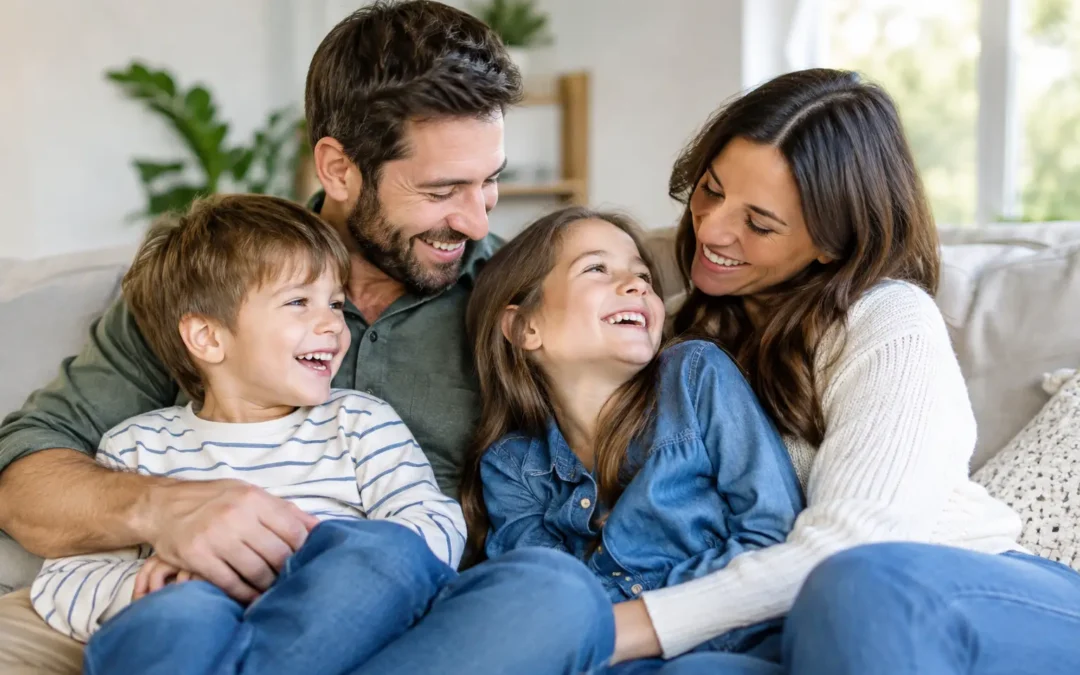
A rainy London afternoon does not have to mean postponing family portraits. Some of the most characterful indoor family photography ideas begin in the places your children know best: curled up on the sofa, reading on a bedroom floor, making tea in a bright kitchen, or piling on to the bed for a giggle. The aim is not to make your home look like a studio. It is to create polished, warm photographs that still feel recognisably like your family.
Start with the room, not the props
Light matters more than square footage. Look around your home at the time of day you hope to be photographed and notice which rooms receive the softest window light. A sitting room with a large window, a calm bedroom or a light kitchen can all work beautifully, even in a compact London flat.
Choose one or two rooms rather than trying to photograph every corner of the house. This keeps the session relaxed and gives children time to settle. Clear away visual clutter that may distract in photographs – paperwork, charging cables and brightly coloured packaging – but do not strip the space of personality. A favourite blanket, a well-loved book or a child’s drawing can say more about this chapter of family life than a perfectly styled shelf.
If your rooms are darker, a professional photographer can use carefully placed supplementary lighting to keep skin tones natural and the atmosphere soft. The trade-off is that the more equipment a space needs, the less spontaneous it can feel. Where possible, booking around good daylight makes the process easier for everyone.
Use window light with confidence
For natural-looking indoor portraits, position your family close to a window rather than directly in front of it. Side light is especially flattering: it shapes faces gently, adds depth and avoids the flat look that overhead ceiling lights can create.
Turn off mixed household lighting if you can. Warm lamps combined with cool daylight often produce uneven colour in photographs, particularly around skin tones. A lamp may still be useful as part of the room’s atmosphere, but it should not be the main source of light on your faces.
Overcast weather is often ideal. Clouds act like a giant diffuser, softening the sunlight and allowing everyone to stay comfortable near the window. Bright sunshine can be lovely too, but it may need a sheer curtain to soften hard patches of light and prevent squinting.
Choose activities that give everyone something to do
The best indoor family photography ideas tend to involve gentle interaction rather than asking everyone to sit still and smile for an extended period. Particularly with younger children, a small activity removes the pressure of being photographed and gives hands, eyes and expressions somewhere natural to go.
Reading a favourite story together is a simple starting point. Baking works well if you are happy for the photographs to include a little flour and real-life mess. Building blocks, drawing at the table, playing a short card game or dressing a baby after bath time can all create lovely moments.
Keep the activity uncomplicated. A complicated craft project can become frustrating, while something familiar lets children stay absorbed in their own world. The photographs are not really about the book or the biscuits. They are about the glances between you, the small hands reaching in, and the laughter that appears when nobody is asked to perform.
Make room for quiet portraits too
Candid images are valuable, but it is also worth making time for a few gently guided portraits. A family gathered on the sofa, parents sitting with children between them, or siblings leaning together on a bed can produce a classic image for the wall or an album.
The key is comfort. Rather than instructing everyone to hold a fixed pose, a photographer may ask you to look at one another, share a joke or squeeze in close. Those small prompts help create photographs that look composed without becoming stiff.
Coordinate clothing without matching exactly
Matching white shirts and jeans are not essential for a cohesive family portrait. In fact, clothes that feel too uniform can date quickly and may make everyone feel less like themselves. Aim instead for colours that sit comfortably together.
Soft neutrals, muted blues, warm greens, gentle pinks and earthy tones usually photograph well indoors. Consider the colours already in the room, too. If your sofa is deep navy or your bedroom has patterned wallpaper, clothing in quieter tones will help keep the focus on faces.
Avoid large logos, very fine stripes and highly reflective fabrics, as these can draw the eye away from the people in the image. Comfort is equally important. Children who dislike a scratchy jumper or unfamiliar shoes will not be persuaded by how smart they look. Choose clothes they can move, cuddle and play in.
Parents often worry most about what they will wear. A simple outfit you feel good in is always the right choice. Neutral separates, a favourite dress or a well-cut shirt can look polished without appearing overly formal. Bring a spare top for small children if snacks, paint or dribble are likely to feature.
Let children lead the pace
A successful family session is not measured by how long children can sit still. It is measured by whether they feel safe, seen and free to be themselves. Some children are immediately curious about the camera; others need a little time to watch from a parent’s lap before joining in.
Plan the session around their best time of day where possible. For many families, this means after a nap and before anyone is too hungry. Have familiar snacks and drinks close by, but choose options that are not likely to leave bright crumbs or sticky hands just before a more formal portrait.
If a child becomes shy or restless, do not treat it as a problem to solve. A change of room, a cuddle, a favourite song or five minutes of play can shift the mood. Often the photographs taken just after a pause have the most open, genuine expressions.
Do not chase perfection
Toddlers rarely cooperate on command, siblings sometimes argue, and babies may need feeding halfway through. These are not failures in a family session. They are part of the rhythm of family life.
A professional portrait photographer will know when to step back, when to offer a playful prompt and when to capture the in-between moments. The photograph of your child laughing while escaping the planned pose may become the one you treasure most.
Build variety into one session
You do not need a huge home or an endless list of setups to create a varied gallery. A change in perspective can make the same room feel entirely different. Begin with everyone together by the window, move to the sofa for relaxed cuddles, then photograph siblings playing on the floor or a parent reading with one child.
Close-up photographs matter as much as wider images. A close portrait can hold the detail of a child’s expression, a parent’s hand around a small shoulder or the way siblings look at one another. Wider images provide context: the room, the toys, the family dog asleep nearby. Together, they tell a fuller story.
It is also worth including every relationship within the family. Parents together, each parent with each child, siblings, and individual portraits all deserve space. Families often have plenty of snapshots of their children, but far fewer photographs that include the adults who make daily life happen.
When a home session is the right choice
At-home photography is especially lovely for new babies, very young children and families who want images with a strong sense of place. There is no travel, no unfamiliar setting, and children can take breaks whenever they need to. It is also a meaningful option if you are about to move house or want to remember a much-loved family home.
A studio may suit you better if your home has very limited daylight, you prefer a cleaner, more minimal finish, or the weather makes your rooms particularly dark. Neither option is automatically better. The right setting is the one in which your family can relax and the final photographs reflect how you want to remember this time.
At Henrietta Photography, the focus is always on helping families feel comfortable enough for real expressions to emerge. A little preparation is useful, but the most lasting photographs usually come from allowing the day to unfold with warmth, patience and a touch of play.